विशेष लेख
Ten Painted Waves on Canvas: The Sea That Shaped Art History
Before me, the ocean breathed. It was calm—not a storm in sight. Yet a bolder wave broke close by, spraying salt onto my face like an urgent summons.
Selene Wilde
लेखक
लेख परिचय
नीचे पूरा लेख पढ़ें।
अनुभाग
समाचार
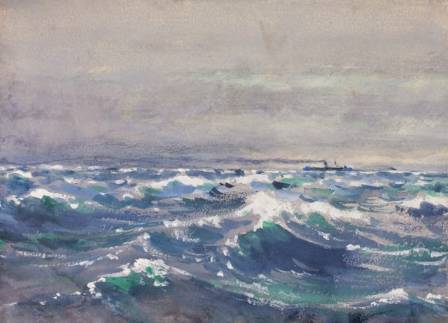
Before me, the ocean breathed. It was calm—not a storm in sight. Yet a bolder wave broke close by, spraying salt onto my face like an urgent summons.
At that instant, tasting the brine and staring at the horizon, it struck me: countless artists have tried to seize the spirit of the sea—its tranquility, its rage, its endless mystery—on canvas.
From that thought comes a list of ten of the most iconic paintings of the ocean, each portraying its moods: serene, reflective, romantic, or awe-inspiring. Every work carries stories and details that reveal the sea’s enduring fascination in art.
Caspar David Friedrich, Ship in the Arctic Ocean, 1798
In this modest yet profound 1798 painting, Friedrich transports us to a remote Arctic setting: a ship trapped among ice floes, leaning helplessly against the power of nature. The scene is dramatic yet composed, reflecting not just a view but the artist’s spiritual vision. For Friedrich, nature is more than scenery—it is a manifestation of the divine. Raised in a devout Lutheran family and shaped by early personal losses, including a brother’s tragic death, Friedrich painted not what he observed, but what he felt in the vastness of the world. At just twenty-four, this work already embodies the Romantic fascination with humanity’s smallness before infinity.
Théodore Géricault, The Raft of the Medusa, 1818–1819
Amid tumultuous waves, salvation is uncertain. Atop a human pyramid, a lone figure waves a cloth in desperate hope, surrounded by the dying and the dead. This is the harrowing core of Géricault’s masterpiece, The Raft of the Medusa.
At twenty-seven, Géricault chose a contemporary tragedy: the shipwreck of the Méduse, whose crew abandoned 147 people to drift on a makeshift raft, with only fifteen surviving after thirteen days—some resorting to cannibalism. To portray this accurately, Géricault studied corpses, morgues, and even preserved body parts to render the anatomical horror with precision. The monumental canvas stunned viewers at the 1819 Salon, earning both acclaim and outrage, and cementing its place in art history.
Katsushika Hokusai, The Great Wave off Kanagawa, 1830
More than a wave, it is a watery beast poised over fragile fishing boats, with serene Mount Fuji in the distance. Hokusai’s print is not only Japan’s most recognized artwork but also one of the most reproduced images globally.
Part of the series Thirty-Six Views of Mount Fuji, it captures the infinite scale of the ocean versus the human smallness. Hokusai incorporated European perspective and circular motion, using the deep Prussian blue imported from the West. Remarkably, he was over seventy when he created it, signing the piece as “The Old Man Mad About Painting” and maintaining eccentric daily rituals, like drawing dragons and tossing them out for luck.
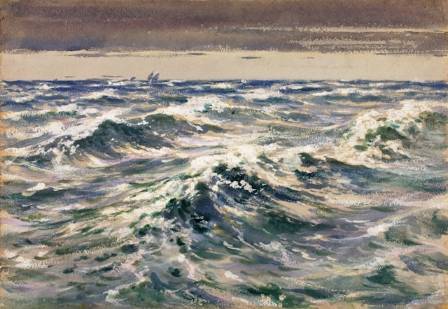
William Turner, The Slave Ship, 1840
At first glance, the canvas is a fiery sunset over turbulent seas. Yet beneath the waves, human bodies—chained, severed, drifting—emerge in a subtle horror. Turner’s painting reflects the 1781 massacre aboard the slave ship Zong, where 133 Africans were thrown overboard for insurance. Displayed in 1840, it served both as a political statement and a revolution in form: the sea becomes near-abstract, overwhelming, and emotive, prefiguring Abstract Expressionism. John Ruskin, the first owner, said it alone would preserve Turner’s immortality.
Édouard Manet, Rochefort's Escape, 1881
A small boat cuts through a restless, metallic sea. Four figures struggle with the current, including Henri Rochefort, rower and hero of a daring escape from a penal colony. Manet transforms a political act into a dramatic tableau, where the real protagonist is water itself. With brisk, energetic strokes, the waves convey tension, isolation, and uncertainty, while history remains a tiny speck on the vast ocean canvas.
Claude Monet, Rocks at Port-Goulphar, Belle Île, 1886
Monet arrived at Belle-Île, a rugged island in Brittany, in 1886, enchanted by jagged cliffs and roaring seas. He painted rocks as living beings, massive and textured, while water vibrates with blues, violets, and whites. Devoid of human figures, the composition immerses viewers in raw nature, a primal dialogue between stone and sea. This work anticipates Monet’s later series, marking a bold step toward abstraction.
John Singer Sargent, Atlantic Storm, 1876
Departing from his famed portraits, Sargent captures the Atlantic mid-storm. Viewed from a ship’s stern, the waves rise like mountains, threatening to engulf the vessel. His swift strokes and icy palette convey urgency and vertigo, documenting the ocean’s overwhelming power. Influenced by Turner, this piece bridges romantic drama and realistic observation—a testament to nature’s force.
Paul Signac, Setting Sun, Sardine Fishing, Adagio, 1891
Signac employs pointillism to depict fishing boats on calm water under a fiery sunset. The “Adagio” title evokes a musical interpretation: suspended boats as visual notes. Dots of pure color merge in the viewer’s eye, harmonizing cool blues with warm yellows, creating a serene, meditative rhythm. Time and narrative fade; the painting becomes a musical meditation on sea, light, and color.
Winslow Homer, The Gulf Stream, 1899
Homer presents a lone Black man adrift in a small, disabled boat amid sharks and a stormy sea. Calm, resilient, and dignified, he symbolizes human endurance and solitude. Surrounding details—a distant ship, torn sails, sugarcane stalks—evoke colonial history and peril. The painting is a haunting study of humanity facing nature’s relentless power.
Joaquín Sorolla, Breakwater, San Sebastian, 1918
Sorolla captures the Atlantic waves crashing against San Sebastián cliffs, while elegantly dressed spectators watch from safety. His luminous, energetic strokes convey motion, contrast, and tension between nature and civilization. Grey-green waters dominate, yet human figures remain calm and orderly. Sorolla’s Impressionist-influenced style renders perception fleeting and sensory, celebrating the momentary power and beauty of the sea.
यह भी पढ़ें

Everything You Need To Know About Carnations
Lily Anderson
एथनिक वियर चुनने के लिए एक व्यापक गाइड: फिटिंग, फैब्रिक और स्टाइल
किशोर मिश्र
Extraordinary Buildings Inspired by Exotic Influences
Gary
शहरी स्काइलाइन्स की नाटकीय तस्वीरें लेने के लिए 4 टिप्स
ज्योति

Extraordinary Insights into Mars: Surprising Realities of the Red Planet
Daniel Whitman

5 कारण क्यों हमें साइकिल चलाना पसंद है
देव