विशेष लेख
Northern Lights: Sharing the Magic of the Aurora
Arctic science often focuses on natural events that cannot be experienced anywhere else on Earth, and few are as closely connected with the Arctic as the northern lights, also known as the aurora. These breathtaking displays appear as glowing curtains of green, red, and sometimes purple light moving across the dark Arctic sky.
Isabelle Rowan
लेखक
लेख परिचय
नीचे पूरा लेख पढ़ें।
अनुभाग
समाचार
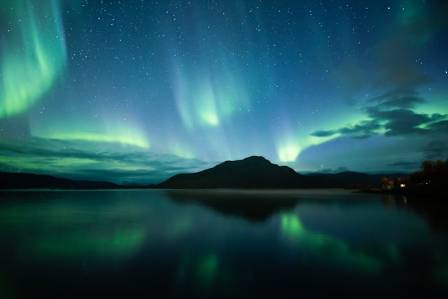
Arctic science often focuses on natural events that cannot be experienced anywhere else on Earth, and few are as closely connected with the Arctic as the northern lights, also known as the aurora. These breathtaking displays appear as glowing curtains of green, red, and sometimes purple light moving across the dark Arctic sky.
One of the world’s best destinations for viewing the aurora is Yellowknife, Northwest Territories, Canada. Located directly beneath the auroral oval, a narrow region surrounding the planet where charged particles guided by Earth’s magnetic field enter the upper atmosphere, Yellowknife offers exceptional viewing conditions.
Whenever the sky is clear and darkness has arrived, visitors have an extremely high chance of witnessing the aurora. The city experiences roughly 100 nights of visible northern lights each year, making it one of the most reliable locations on the planet for aurora viewing.
Experience the Aurora from Anywhere
Not everyone has the opportunity to travel to Yellowknife, but modern technology has made it possible to experience the northern lights from anywhere.
Through a project called AuroraMAX, people can watch live broadcasts of the aurora online during the active aurora season, which usually runs from September through April.
Aurora enthusiasts can also follow the @auroramax Twitter account for updates and alerts about nights when stronger auroral activity is expected.
For those who want to participate more directly in aurora research, The Auroral Zone provides an excellent opportunity. Created by the Arctic Institute of North America and the University of Calgary’s Department of Physics and Astronomy, this citizen science project allows participants to analyze aurora images, identify different types of displays, and learn more about the scientific processes behind them.
Why Do Auroras Glow Green?
Whether you experience the aurora outdoors in the extreme cold of a frozen lake near Yellowknife or observe them comfortably from home with a warm drink beside your computer, their moving waves of colorful light naturally inspire curiosity.
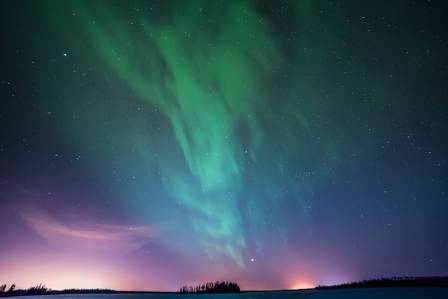
The most common color seen in auroras is green. This occurs when charged electrons traveling along Earth’s magnetic field collide with oxygen atoms and molecules in the upper atmosphere.
These collisions release energy in the form of photons, or tiny particles of light. The color of the light depends on the type of atom or molecule involved.
Green auroras are produced by excited oxygen atoms in a particular state that releases green-colored photons. Since oxygen is common in the upper atmosphere, this color appears most frequently.
Why Do Auroras Sometimes Appear Red?
Although green is the dominant color, auroras can also display beautiful shades of red.
Red light comes from another excited state of oxygen atoms. However, these atoms must remain undisturbed for several seconds after being energized before they can release red photons.
Because the atmosphere is much thinner at higher altitudes, collisions between particles are less common, allowing this process to occur. As a result, red auroras appear higher in the atmosphere than green ones.
Human eyes are also less sensitive to red light, and red auroras are generally much fainter, which is why green is usually the color people notice most.
Why Can Auroras Be Purple or Violet?
At extremely high altitudes, Earth’s atmosphere becomes layered, with lighter particles existing farther above heavier molecules.
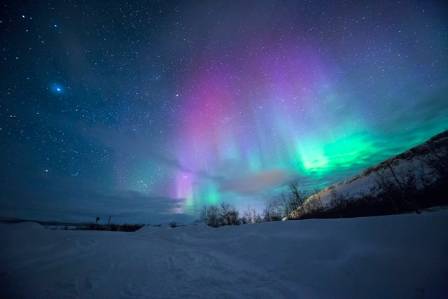
Sometimes a violet or purple band appears near the lower edge of an auroral curtain. This color is created when energetic electrons interact with ionized nitrogen molecules deeper in the atmosphere.
These more powerful electron impacts produce the purple tones that occasionally appear in spectacular auroral displays.
How High Are the Northern Lights?
Although auroras can sometimes appear close enough to touch, they are actually located extremely high above Earth’s surface.
Most auroral activity occurs between approximately 90 kilometers and 400 kilometers above the ground, and some displays can extend even higher into space.
What Creates Different Aurora Shapes?
The forms of auroras remain one of the most fascinating areas of scientific research.
Auroras may appear as flowing curtains, scattered patches, glowing arcs, or circular corona patterns. The exact shape and location depend on complex interactions between solar particles, Earth’s magnetic field, and conditions in near-Earth space.
Scientists continue studying these processes because many details about how different auroral structures develop are still not fully understood.
Do Auroras Really Make Sounds?
Some people who have witnessed the northern lights have described hearing quiet sounds such as hissing, crackling, or gentle swishing noises.
However, scientific studies have not been able to confirm that auroras themselves directly produce audible sounds. At the altitudes where auroras occur, the atmosphere is too thin for sound waves to travel normally.
If these sounds do occur, scientists believe they are more likely created closer to Earth’s surface by related atmospheric processes rather than by the aurora itself.
Can Auroras Be Dangerous?
The northern lights themselves are harmless, but the solar activity responsible for creating them can sometimes affect technology on Earth.
During powerful solar storms, streams of charged particles can interfere with satellites, disrupt communication systems, and create strong electrical currents in power networks. In extreme cases, these effects can lead to satellite failures or power outages.
Indigenous Stories and Legends of the Aurora
Across the Arctic, many Indigenous cultures have developed fascinating stories and traditions connected to the northern lights.
Among Inuit communities in Labrador, one traditional belief describes the aurora as torches carried by spirits helping guide recently departed souls into the next world.
Some legends also explain the occasional sounds associated with the lights, suggesting that the spirits are attempting to communicate with people through their whistles and movements.
These stories reflect the deep cultural connection between Arctic peoples and the mysterious lights that have illuminated their skies for generations.
About the Aurora Research Projects
AuroraMAX is a cooperative project involving the University of Calgary, the City of Yellowknife, Astronomy North, and the Canadian Space Agency. Its goal is to make aurora observations accessible while supporting public understanding of this remarkable natural event.
The Auroral Zone is another educational initiative led by the University of Calgary’s Department of Physics and Astronomy and the Arctic Institute of North America, working together with the Canadian Space Agency, AuroraMAX, and Aurorasaurus.
Through these programs, researchers and the public can work together to explore one of Earth’s most beautiful and fascinating natural phenomena: the northern lights.
यह भी पढ़ें

एथनिक वियर चुनने के लिए एक व्यापक गाइड: फिटिंग, फैब्रिक और स्टाइल
किशोर मिश्र

The life cycle of a sea arch
Eliza Harrington
चढ़ने के लिए 12 सबसे अच्छे पहाड़ 🏔 (मुमकिन चोटियाँ!)
आद्या
हार्वेस्ट गोल्ड इंटीरियर टोन के साथ अपने रहने की जगह को बदलें
रणवीर बिष्ट

पुरुषों के लिए आदर्श स्वेटर चुनने के लिए एक व्यापक मार्गदर्शिका
स्मृति बांगड़

Chinese Fried Dough Sticks
Leander Snow