विशेष लेख
Most Beautiful Medieval Village on the French Riviera
The medieval hilltop village of Èze sits more than 400 meters above sea level, and that elevation is exactly what gives it its almost storybook panorama over the French Riviera. Walking through its winding stone lanes feels like stepping into an endless fortress, where every turn reveals another fragment of sea, sky, and old stone architecture.
Noah Bennett
लेखक
लेख परिचय
नीचे पूरा लेख पढ़ें।
अनुभाग
समाचार
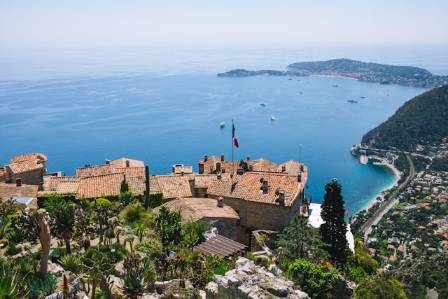
The medieval hilltop village of Èze sits more than 400 meters above sea level, and that elevation is exactly what gives it its almost storybook panorama over the French Riviera. Walking through its winding stone lanes feels like stepping into an endless fortress, where every turn reveals another fragment of sea, sky, and old stone architecture.
Èze Village is located between Nice and Monaco and is often described as having two distinct parts across three levels. Down at sea level lies Èze-sur-Mer, which is crossed by the railway line connecting Nice and Monaco. High above it, perched dramatically on the cliff, is Èze-Village, the medieval settlement described here. Today, this upper village is one of the most visited spots on the Côte d’Azur, largely because of its breathtaking views that seem almost unreal. The entire village resembles a fortified castle, with dense stone walls softened by cascading flowers and greenery.
Things to do in Èze
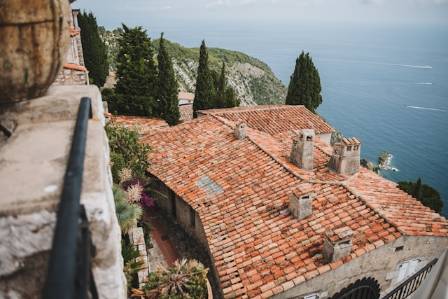
The village itself is the main attraction. Every narrow alley and stone building feels like it carries centuries of history, including traces of well-known visitors. Among them was Walt Disney, who stayed at the Château de la Chèvre d’Or, a luxury hotel partially built from old village houses that cling to the hillside. As you wander through the maze-like streets, you’ll naturally come across its entrances, along with small boutiques, art galleries, restaurants, and workshops run by local artisans.
Water has always been one of the village’s greatest challenges. Èze historically had no natural water source, meaning residents once had to carry water uphill from a spring near the road below. It wasn’t until 1930 that the American composer Samuel Barlow funded the installation of a fountain in the village center, and full connection to a modern water system only arrived in 1952.
A key landmark in the village is the Church of Notre Dame de l’Assomption, a neoclassical building from the 18th century constructed on the site of an earlier religious structure. It was commissioned under Charles Emmanuel III, Duke of Savoy. Inside, the church is richly decorated and worth a visit for its quiet atmosphere and detailed interiors.
Beyond the old village walls, there are two additional highlights worth mentioning. One is the presence of well-known perfume and soap houses such as Galimard and Fragonard, where visitors can explore traditional fragrance-making. The other is the famous hiking route known as the Nietzsche Path, which connects Èze-Village down to Èze-sur-Mer.
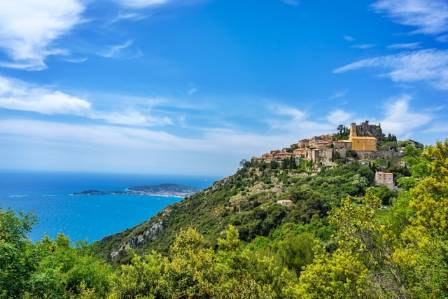
The Exotic Garden of Èze
At the very top of the village lies the Jardin Exotique d’Èze, a garden built on the ruins of the old medieval castle that was destroyed in 1706 under orders from Louis XIV during the War of the Spanish Succession. Today, it is considered one of the most remarkable viewpoints on the French Riviera, second only to the exotic garden in Monaco.
The garden is filled mainly with cacti, succulents, and sculptural arrangements, but its true highlight is the panoramic view over the Mediterranean. Many visitors come less for the plants and more for the sweeping scenery across the Côte d’Azur. The site also features contemporary sculptures by Jean-Philippe Richard, which blend into the landscape in a subtle, artistic way.
One of the most memorable spots in the garden is a quiet viewing terrace set among the rocks. Here, visitors can relax on wooden loungers, listen to the sound of flowing water from a small artificial stream, and take in the wide horizon stretching toward Cap-Ferrat. It is easy to understand why Friedrich Nietzsche found inspiration in this landscape while working on Thus Spoke Zarathustra.
Entry to the garden is around 6 euros, though many would argue the view alone is worth far more. It is open daily, with closing times varying by season, ranging from late afternoon to evening in the warmer months.
Getting to Èze-Village
From Nice, the easiest way to reach Èze-Village is by bus. Line 82 from Rue Barla takes roughly 25 minutes and drops you near the entrance to the old town, with tickets costing about 1.50 euros. Line 112 is another option at the same price. It is important to note that the train does not stop in the medieval village itself—Èze-sur-Mer station is far below, and reaching the hilltop village from there requires a steep climb or additional transport.
यह भी पढ़ें
The Intriguing World of Pufferfish: Nature’s Inflating Survivors
Hugo Sebastian Waverly

चार ऋतुएँ: प्रकृति के बदलते चक्रों की सुंदरता और आश्चर्य की सराहना
विनय
5 सर्वश्रेष्ठ महासागर रोमांच
जेम्स मुलर

इंडोर में जल लिली उगाने और देखभाल करने का तरीका
साहिल
Autumn Cabin Acrylic Painting
Clara Winslow

पतझड़ के पत्तों और आपके यार्ड के लाभ
चंद्र