← मुखपृष्ठ4 मिनट का पाठ
विशेष लेख
Gooderham Tower, Canada’s Most Iconic Flatiron
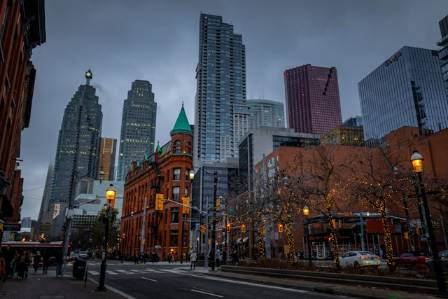
Often called Toronto’s Flatiron Building, the Gooderham Building stands as one of the city’s most cherished landmarks. Located at the junction of Wellington Street and Front Street, it displays remarkable architectural design while also reflecting the legacy of a leading Toronto family that played a major role in the region’s industrial development.
J
Jane
लेखक
लेख परिचय
नीचे पूरा लेख पढ़ें।
अनुभाग
समाचार
Explore the Gooderham Building
Often called Toronto’s Flatiron Building, the Gooderham Building stands as one of the city’s most cherished landmarks. Located at the junction of Wellington Street and Front Street, it displays remarkable architectural design while also reflecting the legacy of a leading Toronto family that played a major role in the region’s industrial development. From its origins in the late 1800s to its current recognition as a heritage property, the building’s history is as compelling as its distinctive form. Today, it serves as office and retail space, with a welcoming pub located on its lower level.
The Gooderham Family
The story of the Gooderham Building is closely tied to the influential Gooderham family, one of Toronto’s most prominent industrial dynasties. Family patriarch William Gooderham, together with his brother-in-law James Worts, founded the Gooderham and Worts Distillery in 1837.
By the late 19th century, the Gooderhams had expanded beyond distilling into banking, shipping, railways, and textile manufacturing. William’s eldest son, George Gooderham, led the distillery and also presided over the Bank of Toronto and the Manufacturer's Life Insurance Company. At the time of his death in 1905, he was among the most affluent and powerful figures in Ontario.
As the family’s enterprises grew, George Gooderham chose to relocate the headquarters of Gooderham & Worts Limited from the distillery to the financial district near St. Lawrence Market. He desired an impressive office that would reflect the family’s success. In 1891, he hired architect David Roberts Jr., who had previously worked on other family projects, to design what would become one of Toronto’s most identifiable buildings.
The Coffin Block
The selected site was a triangular parcel at the meeting point of Wellington Street and Front Street, in what was then a thriving commercial area. This lot was previously the location of the Coffin Block.
Named for its narrow, tapered shape, the Coffin Block was constructed in the early 1800s when this district formed part of Toronto’s original downtown, near the lakefront docks. By the 1890s, the structure had become obsolete, and it was torn down to allow for the new development.
Construction of the Gooderham Building
Work commenced in 1891 and was finished the next year. The unusual triangular form of the building was a direct response to the irregular street pattern. While Wellington Street follows the historic grid of the old Town of York, Front Street aligns with the former shoreline of Lake Ontario, resulting in an angled crossroads. This demanded a creatively designed building to fit the site. The resulting flatiron-style structure was among the first of its kind worldwide, pre-dating New York’s famous Flatiron Building by ten years.
The construction expense reached $60,000—a considerable amount at the time—demonstrating the wealth of the Gooderham empire. It was the most costly office building in Toronto then and soon gained a reputation as a highly desirable business location.
Architectural Design
David Roberts Jr. created the building in a blend of Romanesque and Gothic Revival styles. The façade is built of red brick and includes arched windows, decorative cornices and friezes, and a base of Ohio sandstone. The eastern end is distinguished by a striking tower that housed George Gooderham’s private office. This tower is especially notable for its curved windows and conical copper roof with ornamental dormers. Inside, the building was equipped with one of the earliest electric elevators in Toronto.
Among its most recognizable elements is a large mural on the west wall, painted in 1980 by Canadian artist Derek Besant. Using trompe-l'œil techniques, the mural creates the illusion that the building’s corners are peeling back to show the Perkins Building behind it. This mural has become a popular attraction in its own right.
Preservation and Heritage Status
The building served as the headquarters for the Gooderham and Worts distillery until 1952. As business operations changed, the building was used less, and the Gooderhams sold it in 1957. Despite changes in ownership, its historical and architectural value continued to be recognized.
The City of Toronto designated the Gooderham Building as a heritage property under the Ontario Heritage Act in 1975. In 1977, the Ontario Heritage Trust placed a conservation easement on the site, providing long-term protection.
Renovations
Multiple restoration projects have been conducted over the years to preserve original elements such as decorative friezes, pilasters, and the copper roof, while adapting the interior for contemporary use. Major renovations took place in 1998 under owners Michael and Anne Tippin, and again in 2011 by Woodcliffe Landmark Properties.
Now, more than 130 years after its completion, the Gooderham Building remains one of Toronto’s most photographed and admired structures, second only to the CN Tower. It symbolizes the entrepreneurial drive of the Gooderham family, whose influence continues to shape the city.
Visiting the Gooderham Building
Situated in downtown Toronto, it is within walking distance of other notable sites including St. James Cathedral, St. Lawrence Hall, and St. Lawrence Market, making it an easy addition to any sightseeing itinerary.
Behind the building lies Berczy Park, renovated in 2017, which includes an eye-catching three-tier fountain designed by Montreal landscape architect Claude Cormier. The fountain, featuring 27 cast-iron dogs and one cat, is a popular gathering place and offers a pleasant setting for a break or picnic.
यह भी पढ़ें
hi
सिएटल साउथसाइड में शीर्ष 5 बाइकिंग ट्रेल्स
रिशभ
hi
लहरों की आवाज सुनने से हमें शांति क्यों मिलती है?
तृषा
hi
6 शहर जो सबसे अनूठी वास्तुकला के साथ हैं और वास्तव में अलग खड़े हैं
सिमरन
en
Mount Etna: Earth's Most Active Volcano
Grace Aurora
hi
दुनिया के शीर्ष 3 फूलों के खेत
वेदिका
hi
2025 में दुनिया की 10 सबसे ऊंची इमारतें
अर्जुन