Introduction: Flamingos—Legends of the Wetlands
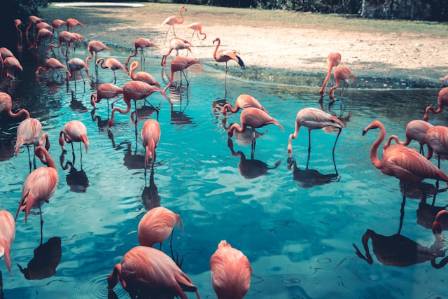
Few creatures embody the elegance of the natural world like the flamingo. With their vivid pink plumage, sinuous S-shaped necks, and iconic one-legged stance, these wading birds have captivated human curiosity for millennia. Found across the Americas, Africa, Asia, and Europe, the six species of Phoenicopteridae family thrive in shallow lakes, lagoons, and coastal wetlands, where they gather in massive flocks that paint the water’s surface with strokes of rose and coral. Their distinctive coloration, a result of carotenoid-rich diets of algae, brine shrimp, and aquatic invertebrates, is just one of their many remarkable adaptations. Yet none is more puzzling—or more fascinating—than their habit of standing on a single slender leg for hours on end, often while resting or feeding. This behavior, observed in flamingos of all ages and species, is far from a mere quirk; it is a masterclass in evolutionary engineering, shaped by millions of years of natural selection to solve critical biological challenges. In this exploration, we unravel the scientific mysteries behind this graceful posture, from energy efficiency to temperature regulation, and discover how it has become a cornerstone of the flamingo’s survival.
The Energy Conservation Hypothesis: Less Effort, More Endurance
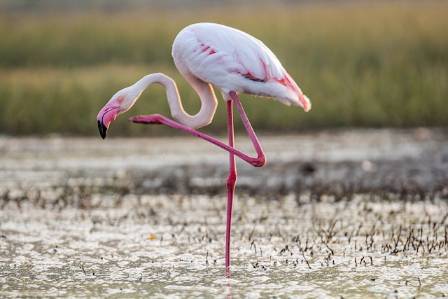
For decades, scientists debated whether flamingos stand on one leg to save energy—and recent research has confirmed this theory with striking precision. A groundbreaking study published in Biology Letters by biomechanists Young-Hui Chang and Lena H. Ting revealed that flamingos expend up to 50% less energy when standing on one leg compared to two. The secret lies in their unique anatomy: a specialized “lock-and-key” joint mechanism in the knee and ankle that allows the leg to lock into place passively, requiring almost no muscular effort to maintain balance. When a flamingo shifts its weight to one leg, its body naturally aligns into a “zero-force equilibrium,” where gravity and skeletal structure do the work instead of muscles. This passive support system is so efficient that even a flamingo cadaver can be balanced on one leg—proof that the stance relies on structural stability, not active muscle control. For birds that spend 12-18 hours a day wading in search of food, this energy savings is invaluable. It allows them to conserve resources for foraging, mating, and escaping predators, giving them a critical edge in environments where food may be scarce or distributed over large areas.
Thermoregulation: Beating the Chill in Cold Waters
Flamingos often inhabit habitats with extreme temperature variations, from the frigid high-altitude lakes of the Andes to the cool coastal lagoons of Europe. As endothermic birds with a body temperature of around 41°C (106°F), they must maintain a stable internal temperature to survive. Their unfeathered legs, which are rich in blood vessels, are a major source of heat loss—especially when submerged in cold water. By tucking one leg against their feathered torso, flamingos reduce their exposed surface area by half, cutting heat loss by up to 50%. This adaptation is not just theoretical: observational studies in zoos and wild habitats have shown a direct correlation between temperature and one-legged standing. A 2017 study in Zoo Biology found that when ambient temperatures dropped below 20°C (68°F), over 70% of flamingos adopted the one-legged stance, compared to just 5% when temperatures exceeded 35°C (95°F). For species like the Andean flamingo, which lives in lakes where water temperatures can dip to 10°C (50°F), this ability to regulate heat means the difference between thriving and struggling to survive. It expands their ecological niche, allowing them to exploit food sources in environments that would be too cold for less-adapted birds.
Biomechanics of Balance: Nature’s Perfect Tripod
The flamingo’s ability to maintain balance on one leg seems almost supernatural, but it is rooted in elegant biomechanical design. Unlike humans, who rely on constant muscle adjustments to stay upright, flamingos use a passive stability system that functions like a self-supporting tripod. Their legs are uniquely structured: the knee joint bends forward (opposite to human knees), and the ankle joint is positioned high up the leg, creating a long, slender lower limb that acts as a stable column. When standing on one leg, the flamingo’s center of gravity aligns perfectly with the supporting leg, and its body sways slightly in a pendulum-like motion—this passive sway corrects for minor imbalances without any muscular effort. Additionally, flamingos often tuck their head under their wing while standing on one leg, shifting their weight even closer to the supporting leg and enhancing stability. Cadaver studies have further demonstrated this mechanical advantage: when researchers positioned a flamingo cadaver on one leg, it remained balanced for over an hour without any external support. This biomechanical ingenuity not only makes one-legged standing efficient but also more stable than standing on two legs—explaining why flamingos can maintain the posture for hours, even while sleeping.
Predator Avoidance: Resting While Remaining Alert
In the wild, rest and vigilance are often conflicting needs—but flamingos have found a way to balance both with their one-legged stance. When standing on one leg, flamingos can quickly deploy their raised leg to escape predators like crocodiles, jackals, or birds of prey. This split-second reaction time is crucial in shallow waters, where predators can lurk just below the surface. Additionally, the one-legged posture may be linked to unihemispheric sleep—a phenomenon where birds sleep with one brain hemisphere while the other remains alert. By standing on one leg, flamingos may physically reinforce this state of partial alertness, allowing them to rest without fully letting their guard down. Another benefit is reduced detection: in shallow water, the sound of a flamingo stepping down can alert predators to its presence. By keeping one leg raised, flamingos minimize both visual and auditory cues, making them less noticeable to threats. While direct evidence for this theory is less conclusive than for energy conservation or thermoregulation, it adds another layer of evolutionary logic to the behavior—turning a resting posture into a survival strategy.
Reducing Muscle Fatigue: The Art of Alternation
Standing for extended periods can cause muscle fatigue in most animals, but flamingos have evolved a clever solution: they alternate which leg they stand on. Research has shown that flamingos are ambidextrous in their stance—they switch between right and left legs every 10-20 minutes, giving each limb a chance to rest. This balanced usage prevents overuse injuries and muscle strain, allowing them to stand for hours or even days in their feeding areas. The lock-and-key joint mechanism plays a key role here too: when a leg is locked into place, the muscles are not under constant tension, reducing fatigue even during prolonged use. Electromyography studies have confirmed this efficiency: muscle activity in a flamingo’s standing leg is less than 10% of what it would be if the bird were using active muscle control to balance. For flamingos, which spend most of their lives on their feet, this adaptation is essential. It allows them to maximize their feeding time without succumbing to exhaustion, ensuring they get enough nutrients to support their large bodies and vibrant plumage.
Social and Behavioral Dimensions: More Than Just a Stance
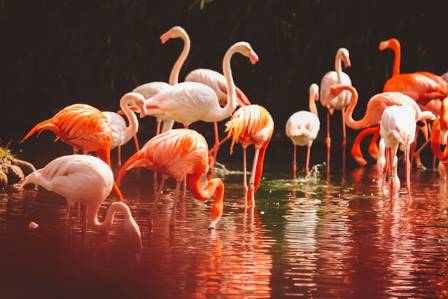
The one-legged posture is not just a biological adaptation—it also plays a role in flamingo social behavior. Flamingos are highly social birds that live in flocks of thousands, and the one-legged stance helps them maintain order in these dense groups. By standing on one leg, individuals can conserve space while still staying close to the flock—a critical advantage, as large groups provide protection from predators. Observational studies have noted that flamingos in the center of the flock (where they are most protected) are more likely to stand on one leg than those on the periphery, suggesting the posture is a sign of comfort and security. Additionally, the one-legged stance may serve as a signal of fitness. A flamingo that can maintain perfect balance for hours demonstrates strength, health, and genetic superiority to potential mates—though this hypothesis requires more research to confirm. Interestingly, juvenile flamingos do not master the one-legged stance immediately; they learn it gradually, practicing for months and often wobbling or using their beaks for support before perfecting the adult posture. This suggests the behavior is a combination of instinct and learned skill, shaped by both biology and social observation.
Comparative Behavior: Flamingos vs. Other One-Legged Standers
Flamingos are not the only birds that stand on one leg—herons, storks, egrets, and some ducks and geese also exhibit this behavior. This convergent evolution (where unrelated species develop similar traits) suggests the stance offers universal advantages in wetland habitats. However, flamingos take the adaptation to extremes: they stand on one leg more consistently and for longer periods than any other bird. Why? The answer lies in their unique ecology. Flamingos feed by filtering water through their specialized beaks, a process that requires them to stand motionless for hours. Other wading birds, like herons, are active hunters that move frequently, so they have less need for prolonged one-legged standing. Comparative anatomy studies have also revealed that flamingos have the most refined lock-and-key joint mechanism among one-legged standers. While herons and storks have similar joint structures, their passive support systems are less efficient, requiring more muscle effort to maintain balance. This specialization allows flamingos to thrive in environments where other birds cannot—turning a common behavior into a unique evolutionary advantage.
Research Challenges and Innovative Methods
Studying flamingo behavior in the wild is no easy task. These birds often inhabit remote, harsh environments—from the salt flats of Bolivia to the volcanic lakes of East Africa—and they are skittish around humans, making close observation difficult. To overcome these challenges, scientists have developed innovative research methods. Long-distance observation with high-powered telescopes and drones allows researchers to record behavior without disturbing the birds. Thermal imaging cameras have been used to measure heat loss from flamingo legs, providing concrete evidence for the thermoregulation hypothesis. Zoo-based studies offer controlled environments: researchers at the Atlanta Zoo, for example, used force plates to measure the energy expenditure of captive flamingos, confirming the energy conservation theory. Perhaps the most surprising breakthrough came from cadaver studies: by dissecting flamingo specimens, scientists discovered the lock-and-key joint mechanism and proved that the one-legged stance is structurally stable. More recently, researchers have attached miniaturized accelerometers and GPS trackers to wild flamingos, collecting real-time data on posture changes, muscle activity, and environmental conditions. These tools are helping scientists unlock even more secrets about this fascinating behavior.
Environmental Factors: When and Why Flamingos Switch to One Leg
Flamingoes do not stand on one leg randomly—their posture is strongly influenced by environmental conditions. Temperature is the most significant factor, as we’ve seen, but water depth also plays a role. In deeper water, where heat loss is greater and energy expenditure to stay upright is higher, flamingos are more likely to adopt the one-legged stance. Wind speed is another variable: increased wind enhances convective heat loss, making one-legged standing more advantageous in breezy conditions. Time of day matters too: flamingos are more likely to stand on one leg during rest periods, especially at night, when they need to conserve energy and stay warm. Even water chemistry can influence the behavior: in highly saline or alkaline lakes (where flamingos often feed), the water is denser and more physically challenging to stand in. The one-legged stance reduces the amount of time each leg is submerged, minimizing exposure to harsh chemicals and reducing energy expenditure. These environmental correlations highlight the flexibility of the adaptation—flamingos adjust their posture to meet the demands of their surroundings, ensuring they always have the upper hand in survival.
Evolution: How the One-Legged Stance Shaped Flamingo History
The evolution of the flamingo’s one-legged stance is a story of gradual refinement over millions of years. Fossil evidence suggests that the ancestors of modern flamingos appeared around 30 million years ago, during the Oligocene epoch. These early flamingos were smaller than their modern relatives and had less specialized beaks, but they already inhabited wetland environments and likely waded for food. As their habitats evolved—becoming more extreme in temperature, salinity, and food availability—natural selection favored individuals with traits that allowed them to stay in feeding areas longer. The lock-and-key joint mechanism likely evolved from minor modifications to the leg bones and joints of ancestral birds, with each incremental change improving energy efficiency and temperature regulation. Genetic studies have identified several genes associated with skeletal development and muscle function that show accelerated evolution in flamingos, suggesting these genes played a key role in the adaptation. Over time, the one-legged stance became a defining trait of the genus, allowing flamingos to exploit ecological niches that other birds could not. Today, this adaptation is so integral to their survival that it is hard to imagine a flamingo standing any other way.
Cultural Significance: Flamingos in Human History and Design
The flamingo’s one-legged stance has not only captivated scientists—it has also left an indelible mark on human culture. Ancient Egyptian artwork, dating back to 2500 BCE, depicts flamingos standing on one leg, evidence that humans have been fascinated by the behavior for millennia. In South American indigenous cultures, flamingos are featured in creation myths and folklore, often symbolizing grace, balance, and resilience. In modern times, the one-legged flamingo has become an iconic symbol in art, design, and popular culture—from lawn ornaments to fashion prints, its silhouette is instantly recognizable worldwide. Beyond aesthetics, the flamingo’s posture has inspired scientific innovation: biomechanists studying the lock-and-key joint mechanism have developed energy-efficient prosthetic limbs and robots that mimic the bird’s passive balance system. Conservationists have also used the flamingo’s cultural appeal to raise awareness about wetland preservation, as these habitats are critical not just for flamingos but for countless other species. The one-legged stance, in short, has become more than a biological adaptation—it is a bridge between humans and the natural world, reminding us of the beauty and ingenuity of evolution.
Conclusion: The Elegance of Evolutionary Design
The flamingo’s habit of standing on one leg is a masterpiece of evolutionary adaptation—one that solves multiple biological challenges with a single, graceful solution. By combining energy conservation, temperature regulation, balance, predator avoidance, and muscle fatigue reduction, this posture has allowed flamingos to thrive in some of the most extreme environments on Earth. From the salt flats of Africa to the high-altitude lakes of South America, the one-legged stance is a constant reminder of nature’s ability to find elegant solutions to complex problems. As research continues to advance, we may discover even more layers to this behavior—additional benefits or mechanisms that we have yet to imagine. But for now, we can marvel at the flamingo’s grace and resilience, and appreciate the millions of years of natural selection that shaped this iconic posture. In a world where survival often depends on adaptability, the flamingo stands tall—on one leg—as a testament to the power of evolution.