विशेष लेख
Sagalassos: The Rise and Fall of a Pisidian Gem in Ancient Anatolia
Nestled within the western Taurus Mountains of modern-day Turkey, Sagalassos stands as one of the most remarkable archaeological sites in the region once known as Pisidia. This ancient city, whose ruins lie amid the mountainous landscapes of Burdur, Isparta, and Antalya provinces, was home to the Pisidians—an Indo-European people descended from the Luwians. Surrounded by forested hills, river valleys, and fertile plains dotted with lakes, Sagalassos’ geography shaped its destiny for millennia, from prehistoric settlements to its eventual decline as a medieval fortress. Spanning over 2,000 years of human history, the city bears witness to the ebb and flow of empires, the evolution of urban life, and the resilience of communities amid political upheaval and environmental change.
Theodore
लेखक
लेख परिचय
नीचे पूरा लेख पढ़ें।
अनुभाग
समाचार
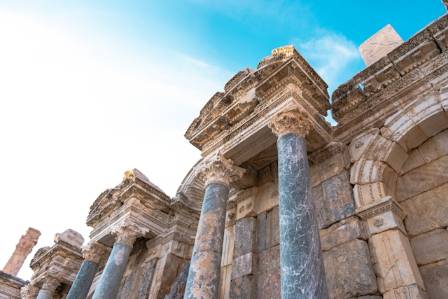
Nestled within the western Taurus Mountains of modern-day Turkey, Sagalassos stands as one of the most remarkable archaeological sites in the region once known as Pisidia. This ancient city, whose ruins lie amid the mountainous landscapes of Burdur, Isparta, and Antalya provinces, was home to the Pisidians—an Indo-European people descended from the Luwians. Surrounded by forested hills, river valleys, and fertile plains dotted with lakes, Sagalassos’ geography shaped its destiny for millennia, from prehistoric settlements to its eventual decline as a medieval fortress. Spanning over 2,000 years of human history, the city bears witness to the ebb and flow of empires, the evolution of urban life, and the resilience of communities amid political upheaval and environmental change.
Prehistoric Foundations: Early Human Activity in Pisidia
The story of Sagalassos begins long before written history, with the first traces of human presence dating to the Middle Palaeolithic era (150,000–45,000 BP). Lithic artifacts, characterized by Levallois reduction techniques, attest to early hunter-gatherer activity in the region. Yet evidence of sustained occupation before 6500 BCE remains scarce. Most prehistoric settlements in the Burdur Plain—such as the famous mound sites of Hacılar and Kuruçay Höyük—emerged during the Late Neolithic and Early Chalcolithic periods (6500–5500 BCE), strategically located near freshwater sources and fertile land for agriculture. These communities relied on a mixed subsistence strategy of crop cultivation and animal husbandry, laying the groundwork for sedentary life in the region.
A mysterious gap in human activity followed the Middle Chalcolithic (5300–4300 BCE), with no direct evidence of occupation in the Burdur Plain for 1,500 years. It was not until the Late Chalcolithic and Early Bronze Age (4200–2000 BCE) that settlements reemerged, forming a dense network across the landscape. By 800 BCE, human impact on the environment became detectable in pollen records, though the lack of spatial correlation between archaeological sites and environmental data makes it difficult to link these changes to specific communities.
For Sagalassos itself, the Iron Age (1200–550 BCE) remains a shadowy period. Only two pottery sherds—dated to the 7th–6th centuries BCE—and a single black-on-red fragment from the 8th–6th centuries BCE have been unearthed in suburban surveys of the Ağlasun valley. This scarcity suggests the area was sparsely populated, with small villages and scattered farms rather than a formal urban center. The nearest significant settlement was Düzen Tepe, a village on a plateau 1.8 kilometers southwest of Sagalassos, where traces of habitation from this era have been identified.
Persian and Macedonian Conquests: The Birth of a City
In 546 BCE, the Achaemenid Persian Empire, led by Cyrus the Great, conquered the Lydian kingdom, absorbing Pisidia into its vast territories spanning from Anatolia to North India. The first definitive evidence of occupation at Sagalassos dates to the late Achaemenid period (late 5th century BCE), though recent archaeological research downplays direct Persian cultural or administrative influence on local communities. Instead, this era marks the gradual formation of a settled community at Sagalassos, alongside other small settlements in the Ağlasun valley.
The balance of power shifted dramatically in 334 BCE, when Alexander the Great of Macedon launched his campaign against the Achaemenid Empire. According to the Roman historian Arrian, Alexander captured Sagalassos in 333 BCE after overcoming local resistance on a steep conical hill south of the settlement. Arrian described Sagalassos as “not a small city,” but archaeological evidence suggests it was likely a modest village at the time—one that would soon be transformed by its integration into the Hellenistic world.
Hellenistic Era: Urbanization and Regional Dominance
Following Alexander’s death in 323 BCE, Pisidia passed through the hands of successive Hellenistic dynasties: the Antigonids (321–281 BCE), the Seleucids (281–188 BCE), and the Attalids of Pergamon (188–133 BCE). This period witnessed the gradual urbanization of Pisidia, as scattered communities coalesced into larger territories centered on key cities like Termessos, Selge, and Sagalassos. By the early 2nd century BCE, Sagalassos had expanded its territory to include the fertile Burdur Plain, possibly as a result of Seleucid policies encouraging regional consolidation.
Hellenistic settlements in Pisidia often featured fortifications or elevated locations, reflecting ongoing concerns about security rather than purely agricultural needs. At Sagalassos, this era laid the groundwork for future urban growth, with the first signs of organized public spaces and infrastructure. Yet the extent of Hellenistic influence on Pisidian culture remains a subject of scholarly debate, as local traditions persisted alongside Greek architectural and administrative practices.
Roman Rule: The Golden Age of Sagalassos
In 133 BCE, the last Attalid king, Attalos III, bequeathed his Anatolian territories to the Roman Republic. Pisidia was initially incorporated into the province of Asia in 129 BCE, but Roman control remained nominal until the mid-1st century BCE, when Rome defeated King Mithridates VI of Pontus and the Cilician pirates. After decades of conflict, Pisidia came under the rule of Amyntas of Galatia in 36 BCE, and following his death in 25 BCE, the region was formally absorbed into the Roman province of Galatia by Emperor Augustus.
The Roman Imperial period marked Sagalassos’ golden age, with unprecedented urban expansion and architectural grandeur. Mass pottery production, already initiated in the Late Hellenistic era, flourished under Augustus, as local potters developed a distinctive fine tableware known as Sagalassos Red Slip Ware (SRSW). This pottery, produced until the 7th century CE, became a staple of regional trade and daily life, with production centered in the city’s Eastern Suburbium—a district that combined pottery workshops, artisanal activities, housing, cemeteries, and waste disposal (once called the “Potter’s Quarter”).
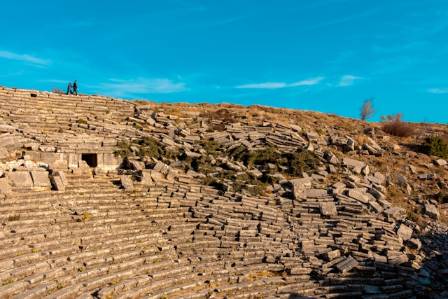
Urban development accelerated under successive emperors. During the reign of Nero (54–68 CE), public building projects continued apace, but the city reached new heights under Hadrian (117–138 CE), who oversaw a “building boom” that transformed Sagalassos’ skyline. Key structures from this era include the Neon Library, the Hadrianic Nymphaeum (a monumental fountain), the Temple of Apollo Klarios, and the massive Roman Baths. The Baths were completed under Marcus Aurelius (161–180 CE), along with the Macellum (a covered market) between the Lower and Upper Agora. It is likely that the city’s impressive theatre—one of Turkey’s largest Roman odeons, with a capacity of 2,500—was also initiated during this period.
Sagalassos thrived as the preeminent city of Pisidia, with elites and commoners alike leveraging the opportunities of Roman imperial rule. Its urban infrastructure—including colonnaded streets, porticoes, and public squares—rivaled that of larger Anatolian cities. Even after the Roman Empire’s administrative reorganization in the early 4th century CE, which shifted regional power to Pisidian Antioch, Sagalassos continued to flourish, with ongoing maintenance of its public buildings and urban spaces.
Byzantine Transformation: Christianity and Urban Decline
The 4th century CE brought the rise of Christianity, and by the 5th–6th centuries, Sagalassos had embraced the new faith. Eight churches were constructed within the city and its periphery, while existing Roman structures—including the Baths complex, agoras, and streets—remained in use and well-maintained. This period of transition saw Sagalassos adapt to a Christian worldview, with religious buildings replacing pagan temples as the city’s spiritual and social centers.
By the late 6th century CE, however, signs of urban decline emerged. Public spaces and buildings were increasingly subdivided into smaller units for residential or craft use, a process known as “encroachment” that reflected shifting economic and social priorities. The production of SRSW, long a cornerstone of the city’s economy, ceased in the Eastern Suburbium, possibly relocating to rural workshops in the surrounding countryside.
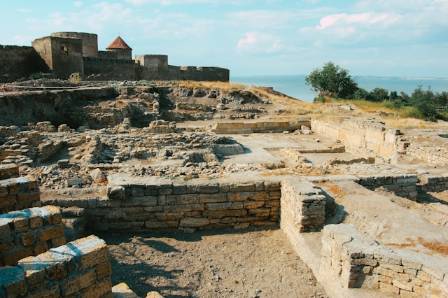
The decisive blow came in the 7th century CE, when a devastating earthquake destroyed much of Sagalassos’ public architecture. For decades, scholars believed this disaster marked the end of the city, but recent excavations have revealed that occupation continued until the 13th century. Survivors repaired key structures—including the basilica built on the site of the former bouleuterion (council house)—and constructed a defensive wall across the southern part of the colonnaded street. The community relocated to a kastron (fortress) on the plateau of the partially dismantled Sanctuary of Antoninus Pius, where they clung to a diminished urban existence.
The Final Chapter: Medieval Abandonment and Legacy
Sagalassos remained a bishopric of the Byzantine province of Pisidia into the medieval period, a sign of its enduring religious significance. The kastron was occupied until the early 13th century, when the destruction of a fortress on Alexander’s Hill likely spelled the end of organized community life at the site. With the rise of the Anatolian Seljuk Sultanate, the remaining inhabitants abandoned the mountain slopes and relocated to the valley bottom, where the modern village of Ağlasun developed.
Today, Sagalassos stands as a UNESCO World Heritage Tentative Site, its ruins a testament to the ingenuity of the civilizations that shaped it. From its humble prehistoric origins to its Roman golden age and Byzantine transformation, the city offers a unique window into the dynamics of urban life in ancient Anatolia. Archaeological research—led by teams from Belgium’s Katholieke Universiteit Leuven and Turkish institutions—continues to uncover new insights into its history, from the daily lives of its residents to the global trade networks it participated in.
Sagalassos’ legacy is not merely architectural; it is a story of adaptation and resilience. Over millennia, it evolved from a small village to a regional capital, weathered conquests and earthquakes, and transformed its identity amid shifting cultural and religious tides. For modern visitors, the ruins of Sagalassos—set against the stunning backdrop of the Taurus Mountains—offer a powerful connection to the past, reminding us of the impermanence of empires and the enduring spirit of human settlement.
यह भी पढ़ें

A Complete Guide: How to Style Women’s T-Shirts
Mia

अपने बगीचे को सजाने के लिए 16 फूलों की क्यारियाँ
उत्कर्ष

हरे भरे स्थान, खुशहाल स्थान: भू-दृश्य और लॉन की देखभाल का कलात्मक मिश्रण
श्रेया

14 Best Women's Suits for 2026
Daniel

A Culinary Journey: 15 Iconic Chinese Dishes
Michel Chen

Fascinating Discoveries About the World of Turtles
Hazel Victoria Ellington